The Gospel
in Danger
Paul defends his apostleship and immediately condemns the “different gospel” troubling the churches.
1:6–9 · No other gospelThe gospel, Christian freedom, and life in the Spirit.
Paul defends his apostleship and immediately condemns the “different gospel” troubling the churches.
1:6–9 · No other gospelHis gospel came by revelation from Christ, not Jerusalem. His confrontation with Peter points to justification through faith in Christ, not works of the law.
2:15–21 · Justified by faithAbraham was justified by faith. The Mosaic law was temporary and subordinate to the promise, leading to Christ. Believers are sons and heirs, not slaves.
3:6–29 · Promise fulfilledFreedom is not license: walk by the Spirit, serve one another, do good, and boast only in Christ’s cross.
5:16–26 · Walk by the SpiritThe readers were churches Paul and Barnabas established on their first missionary journey: Pisidian Antioch, Iconium, Lystra, and Derbe (Acts 13–14), rather than an otherwise poorly documented mission to ethnic Galatia farther north.
Barnabas is familiar. He appears repeatedly (Gal. 2:1, 9, 13), and he accompanied Paul when the southern churches were founded.
Illness occasioned Paul’s preaching. Galatians 4:13–14 may fit the more accessible southern cities better than mountainous northern Galatia.
“Formerly” need not mean two separate journeys. Galatians 4:13 can mean “formerly”; Paul visited the southern churches on the outward and return legs of the first journey (Acts 14:21).
Possible echoes at Lystra. The welcome in Gal. 4:14 may recall Acts 14:11–12; the bodily marks in Gal. 6:17 may recall Acts 14:19. These are suggestive but weak clues.
The evidence is not conclusive; this study regards the South Galatian case as considerably stronger.
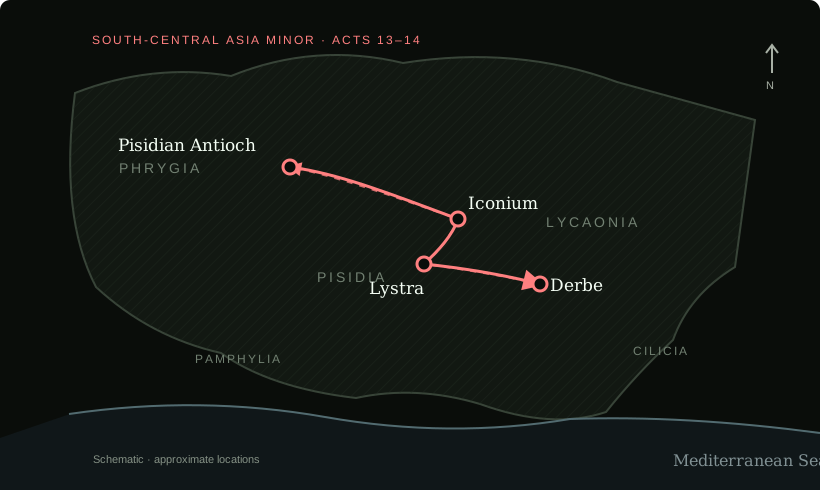
Teachers said Gentile converts needed circumcision and the Mosaic law in addition to faith in Christ (Gal. 5:2–4; 6:12–13). They also challenged Paul’s apostolic authority.
On this view, Gal. 2:1–10 describes the earlier visit to Jerusalem (Acts 11:27–30).
The proposed date is just before the Jerusalem Council of Acts 15.
Paul’s letter does not cite the council’s decree, a potentially powerful argument against requiring circumcision.
Acts 18:12–17 · Corinth
The Gallio inscription does not directly date Galatians. The Delphi inscription identifies Gallio as proconsul of Achaia and places Paul’s appearance before him around A.D. 51–52. An A.D. 48 letter would fall a few years earlier.

Adding Torah observance as necessary for salvation fundamentally changes the gospel.
1:6–9A person is justified through faith in Christ, not by “works of the law.”
2:16–21 · 3:6–14The Abrahamic promise comes first; the law had a temporary, preparatory role until Christ.
3:15–25Jew and Gentile become one family and heirs of Abraham’s promise.
3:26–29 · 4:4–7Christ frees believers from bondage to the law; freedom becomes loving service, not indulgence.
5:1 · 5:13–14Christian holiness comes through walking by the Spirit and bearing the Spirit’s fruit.
5:16–26The decisive reality is neither circumcision nor uncircumcision, but new creation through the cross.
6:14–15Galatians 1:1–2:14
Paul was sent by Jesus Christ and God the Father (1:1). Christ gave himself for our sins to deliver us from the present evil age (1:3–5).
The Galatians are turning to a different gospel (1:6–9). Paul condemns any change to the gospel, even if he or an angel were to preach it. He seeks God’s approval (1:10).
The question: Must Gentiles keep the Mosaic law? Paul addresses this through Titus’s circumcision (2:3–5) and Peter’s refusal to eat with Gentiles (2:11–14).
Paul received his gospel by revelation from Jesus Christ (1:11–12). He had previously persecuted the church (1:13–14).
Set apart before birth. God elected Paul to preach Christ among the Gentiles (1:15–17).
Called by grace. God called him while he was a persecutor.
Before Jerusalem. Paul went to Arabia, then returned to Damascus.
Paul persecuted the church and was zealous for Jewish traditions. Acts 9:1–2 places him on the road to Damascus.
Paul went to Arabia and returned to Damascus. The length of each stay is unknown.
About three years after his calling, Paul visited Peter for fifteen days. He also saw James, the Lord’s brother.
Length of stay unknown. The Judean churches had heard of Paul’s conversion but did not know him personally.
Barnabas brought Paul from Tarsus in Cilicia to Antioch in Syria. They taught there together for one year (Acts 11:26).
Paul went with Barnabas and Titus to meet the leaders privately. The visit’s length is unknown.
Peter ate with Gentiles, then withdrew when men came from James. Paul confronted him. No duration is given.
The fourteen years may be counted from Paul’s calling or his first Jerusalem visit. That gives roughly fourteen or seventeen years from his calling, allowing for ancient inclusive counting. The three years include Arabia and Damascus; they are not three years in Arabia alone.
This course follows the view that 2:1–10 refers to the famine-relief visit (Acts 11:27–30; 12:25). Paul and Barnabas brought aid on that visit. Others identify it with the council in Acts 15. See the discussion of the date.
Companion: None named in Galatians.
Met: Peter and James, the Lord’s brother. Stayed with Peter fifteen days.
Purpose: To become acquainted with Peter. Acts 9:26–30 also records Barnabas introducing Paul and Paul preaching in Jerusalem.
Companions: Barnabas and Titus, an uncircumcised Greek.
Met: James, Peter, and John (2:9). False brothers also appear in the dispute (2:4).
Purpose: Paul went by revelation to present his Gentile gospel privately to the leaders, concerned that his work might be in vain. They added nothing, extended fellowship, and asked him to remember the poor.
1:1, 11–12. Christ sent Paul and revealed the gospel to him.
1:13–16. God called him by grace to preach to the Gentiles.
1:17–24. He preached before meeting the Jerusalem apostles. His first visit was brief.
2:1–10. The Jerusalem leaders added nothing to his gospel and recognized his apostleship.
2:11–14. He rebuked Peter when Peter’s conduct was contrary to the gospel.
Titus was Greek. Paul did not yield to demands that he be circumcised, preserving the truth of the gospel (2:3–5).
Gentiles do not need circumcision to belong to Christ. Works of the Mosaic law cannot justify anyone; Paul states this in 2:16.
Later, Paul circumcised Timothy because of the Jews in that area (Acts 16:1–3). Timothy’s mother was Jewish and his father Greek. This was an accommodation for preaching, not a requirement for salvation. With Titus, that requirement was the issue.
God sent Peter to preach to the Jews.
2:7–8God sent Paul to preach to the Gentiles.
2:7–8James, Peter, and John gave Paul and Barnabas the right hand of fellowship.
2:9Paul and Peter preached the same gospel. Their primary audiences differed. The leaders agreed with Paul’s message (2:6–9) and asked him to remember the poor (2:10).
Peter ate with Gentile believers.
When men came from James, Peter withdrew out of fear. The text does not say James told him to withdraw.
Other Jews followed Peter, including Barnabas.
Paul asked Peter publicly why he was compelling Gentiles to live like Jews.
Peter’s withdrawal pressured Gentiles to adopt Jewish practices. Paul rebuked his conduct because it contradicted the gospel they both preached.
Galatians 2:15–3:29
Even Jewish believers must be justified through faith in Christ. Works of the law cannot justify anyone (2:16). Returning to what Paul has torn down makes him a transgressor; it does not make Christ a servant of sin.
Paul has died to the law to live to God. He has been crucified with Christ and now lives by faith in the Son of God. If righteousness could come through the law, Christ died for nothing (2:21).
Paul no longer lives under the law as the covenant governing his relationship with God. His life is in Christ. Going back to works of the law for justification sets aside God's grace.
Paul's main contention with the Galatians comes into focus here. They received the Spirit through hearing with faith, yet now turn to works of the law as though these could complete what God began. In this argument, finishing in the flesh means relying on human effort through law observance.
Paul calls them foolish. Christ had been preached to them as crucified, but their search for justification through the law denies the necessity of his death (2:21). This explains the force of his rebuke.
Paul quotes Genesis 15:6: “Abraham believed God, and it was credited to him as righteousness” (Gal. 3:6, BSB). Those who have faith are Abraham's children. The promise that all nations would be blessed through him includes the Gentiles (Gen. 12:3; Gal. 3:8).
Abraham is the example of those who believe God. People of faith share his blessing.
3:6–9Abraham was counted righteous before circumcision. He is the father of believers, both circumcised and uncircumcised.
4:3, 9–12, 16–22Abraham's faith worked with his obedience in offering Isaac. His actions brought his faith to completion, fulfilling Genesis 15:6.
2:21–24; Genesis 22Paul and James both use Abraham as an example of faith and quote Genesis 15:6. Paul rejects works of the law as the basis of justification. James rejects a claim to faith that produces no obedience.
Deuteronomy 27:26 places under a curse those who do not keep everything the law requires. Those relying on works of the law face this curse. Paul also quotes Habakkuk 2:4 and Leviticus 18:5 to contrast living by faith with the law's requirement to do its commands.
Christ redeemed us by bearing the curse in his death. Paul applies Deuteronomy 21:23 to Christ's crucifixion. Through Christ, Abraham's blessing reaches the Gentiles, and we receive the promised Spirit through faith.
Christ's death brings the change Paul describes: redemption from the curse, followed by life in Christ. In 3:23–25 he explains that we are no longer under the law's guardianship.
God gave Abraham the inheritance by promise. The law came 430 years later and could not cancel that promise (3:17–18). Paul identifies Christ as the promised seed (3:16). The promise takes priority over the law and finds its fulfillment in Christ.
The law was added because of transgressions until the promised seed came (3:19). It is not opposed to God's promises, but it cannot give life (3:21–22). It served as a guardian until Christ; now that faith has come, we are no longer under that guardian (3:23–25).
We are sons of God through faith in Christ. Those baptized into Christ have clothed themselves with Christ (3:26–27). Paul assumes baptism as part of the experience shared by the believers he addresses.
Jew or Greek, slave or free, male or female—all are one in Christ. Those who belong to Christ are Abraham's offspring and heirs of the promise (3:28–29). Faith, rather than adopting the Mosaic law, marks Abraham's family (3:7).
Paul likewise says that all were baptized in one Spirit into one body, whether Jews or Greeks, slave or free. Baptism and unity in Christ belong together in both passages. He identifies this body as Christ's body in 1 Corinthians 12:27.
Galatians 2:15–3:29 · Quoted wording below is from the BSB text of Galatians. The last two entries distinguish quoted phrases and possible echoes from full quotations.
3:6 → Genesis 15:6. “Abraham believed God, and it was credited to him as righteousness.” Abraham is Paul's example of righteousness through faith.
3:8 → Genesis 12:3; compare 18:18 and 22:18. “All nations will be blessed through you.” The promise anticipates the blessing of Gentiles through faith.
3:10 → Deuteronomy 27:26. “Cursed is everyone who does not continue to do everything written in the Book of the Law.” The law requires complete obedience.
3:11 → Habakkuk 2:4. “The righteous will live by faith.” Paul uses this to explain why the law cannot justify.
3:12 → Leviticus 18:5. “The man who does these things will live by them.” The law requires doing its commands.
3:13 → Deuteronomy 21:23. “Cursed is everyone who is hung on a tree.” Christ bore the curse for us.
3:16 → Abraham's seed promises. Paul quotes the phrase “and to your seed” and identifies the seed as Christ. Compare Genesis 12:7; 13:15; 17:7–8; 22:18. These promises provide the background rather than one uniquely identified source verse.
2:16 → Possible echo of Psalm 143:2. Paul's statement that no one is justified by works of the law recalls the psalm's statement that no one living is righteous before God. This is an echo, not an explicit quotation. The references to Abraham's offspring in 3:19 and 3:29 also recall the Genesis promises.
Galatians 1:1–3:29